If We Can Recognize the Objects or People in a Work of Art It Is
 This story is brought to you by vapor-distilled smartwater, who found unique inspiration for their h2o by looking upward to the sky. We hope the change in perspective this piece offers will assist inspire you.
Though today's artists have a world of engineering science at their fingertips, many all the same choose to piece of work in a more traditional manner. These are not painters who create works using oil, acrylic or watercolor – they're artists who take everyday objects similar matches, buttons and nails to make intricate artworks that deserve a closer wait.
Using thousands of separate pieces, these artists create highly detailed sculptures and installations that require a cracking bargain of skill and an unbelievable amount of patience. While examining their works, not only practise nosotros get to appreciate how ordinary objects accept been turned into something extraordinary, nosotros go to stand back in awe and capeesh the creativity and ingenuity that lives within u.s.a. all.
Today, we're proud to present seven artists who, in their own unique mode, have inspired us with a commitment to their craft. These are the artists who have both the confidence and foresight to recognize that by spending weeks (or even months!) meticulously arranging thousands of pieces, they can create a magnificent artwork that we all won't shortly forget. From the London-based artist who suspends flowers from ceilings to an Orange Canton, California-based artist who drills screws to create 3-dimensional portraits, these are the ones who push artistic boundaries (and, in doing so, inspire a legion of fans to follow in their footsteps).
Check out our acme seven artists who inspire us with their utilize of ordinary objects in art.
ane. Rebecca Louise Police force (Floral Artist)
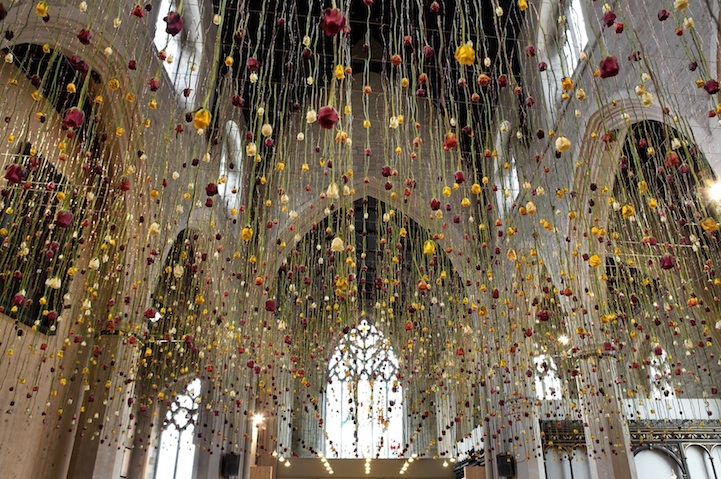
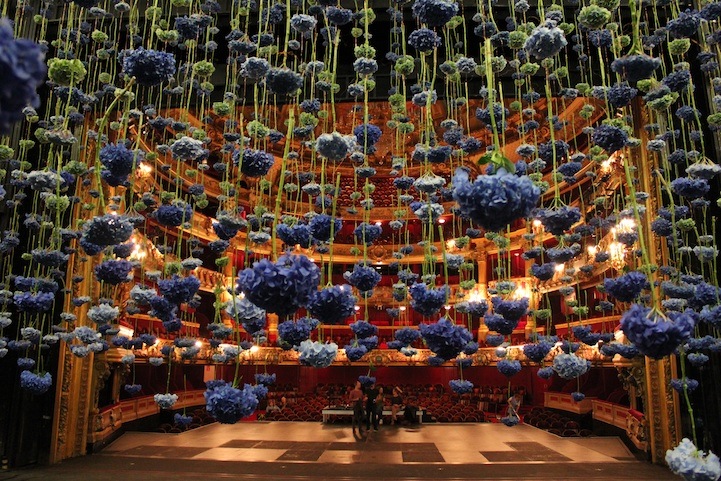
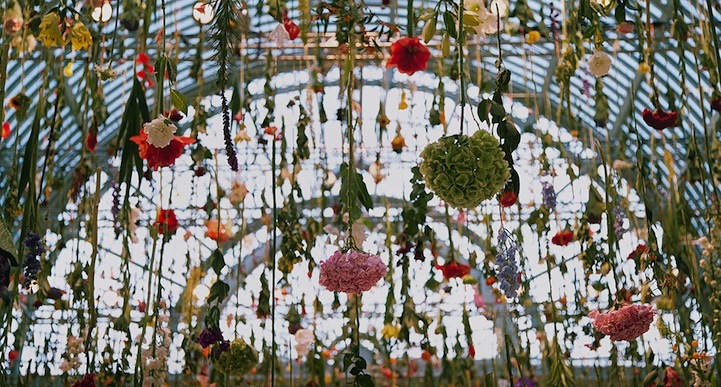
Artist Rebecca Louise Law immerses viewers in her beautifully surreal upside downward gardens. In i mean solar day, Law typically works with a team of 10 to 40 people to create these whimsical installations that make you feel as though you've stepped into Wonderland. Her greatest challenge is the imperceptible nature of flowers: At the start of each installation, she keeps in mind how she is going to persevere the flowers so that they terminal longer than one week. As she explains, "Timing at the first stage of the installation is crucial, as I similar the whole installation to dry at the aforementioned rate."
Last twelvemonth, Police was commissioned by London's Garden Museum to create the site-specific installation Roses. Over 3,000 multicolored roses were hung on copper wire and ethereally suspended from the museum's principal building. Until July 18th, you can see her latest work, alongside those by artists Damien Hirst, Beth Carter, Kathy Dalwood and Patrick Haines, in the exhibition Odyssey at The Church of St Edmund the King in London.
2. Christian Faur (Crayons)
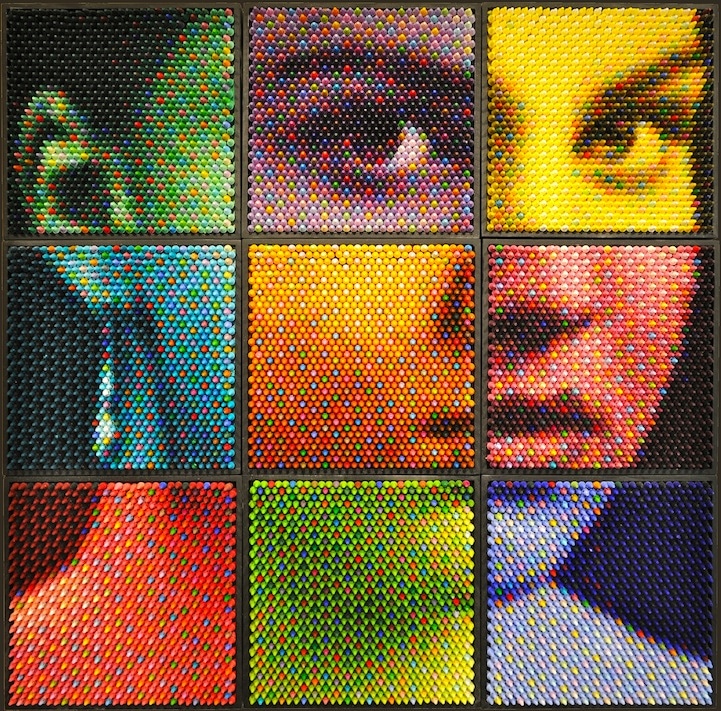
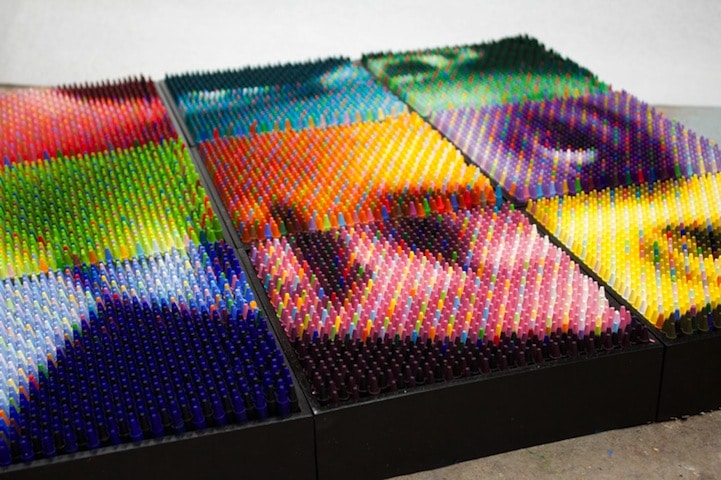
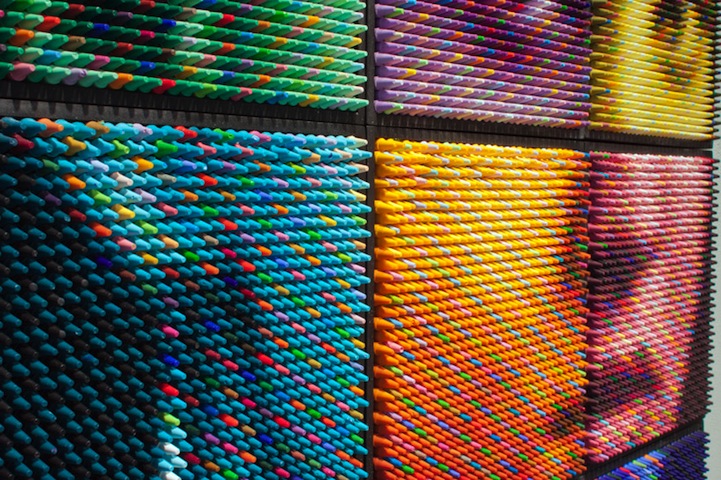
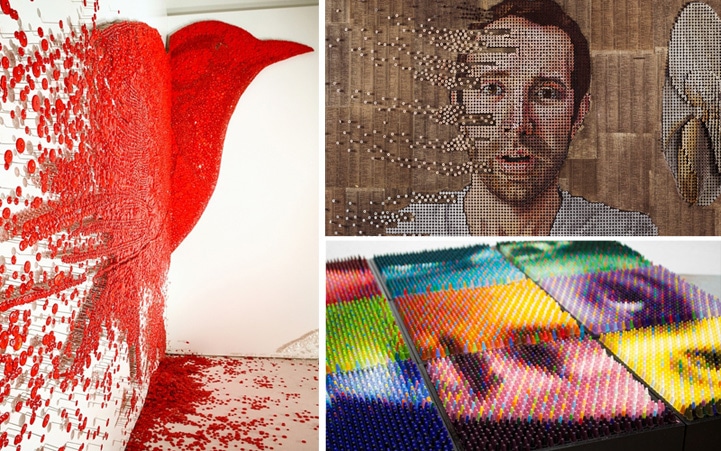
While many of usa haven't picked upwardly crayons since we were kids, creative person Christian Faur sees them as a natural part of his everyday life. The creative person doesn't buy crayons off of store shelves – he makes them by hand using a special mixture of beeswax, crystals and pigments. And then he advisedly arranges them similar pixels until they form a photorealistic portrait of a person.
Faur faces two sets of challenges. Beginning, his compositions must be strong plenty so that the works tin can stand on their ain, beyond the material he uses or the techniques he employs. 2d, he must go along in mind how the works will be portrayed (which, in this 24-hour interval and historic period, is generally through small mobile telephone or tablet screens.)
"A typical foursquare icon on the iPhone has 60 x sixty pixels with millions of possible colors," he says. "Many of my compositions completely fail at this resolution, and never get made." To assistance with this limitation, Faur relies on portraiture. "Believe it or not, the human face requires the least amount of resolution, equally nosotros're 'hard-wired' to run across faces: Our brains fill in the gap when the resolution is missing. If I were to attempt and create a cactus, cup or carrot at the same resolution, the photographic nature of the work would not be perceived." This "filling in" gives the work a magical quality when viewed in a gallery. "As y'all slowly approach the piece of work, the paradigm gets more difficult to perceive. Then, when the brain sees the crayons as individual objects, the overall epitome is lost. I love watching people move closer and farther from the work, trying to understand where the real image resides."
If yous can't run across Faur'due south works in person, he has an eBook called A Box of Crayons which allows users to look at a complete crayon work and and then swipe to run across its many detailed shots. (The creative person wanted to mimic a gallery experience by providing people with multiple views of the same piece.) Alternately, you tin await for Faur's adjacent bear witness, a solo exhibition at New York's Kim Foster Gallery one-time in 2015.
3. David Foster (Nails)
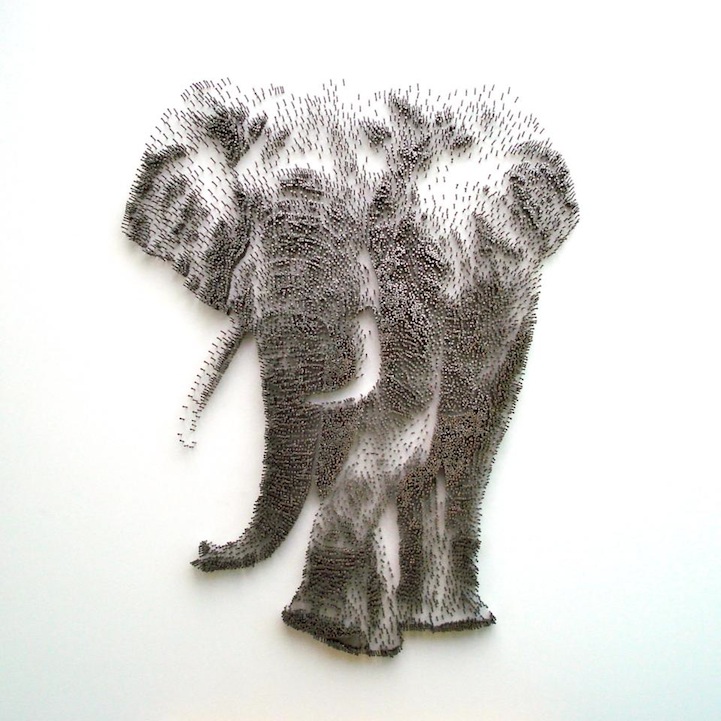
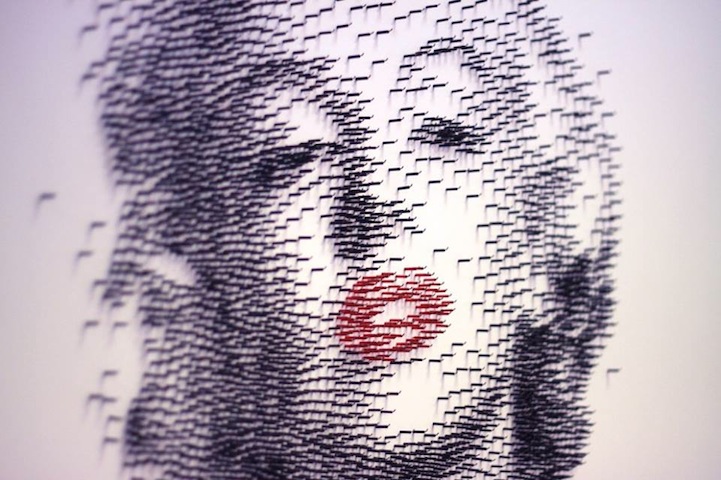
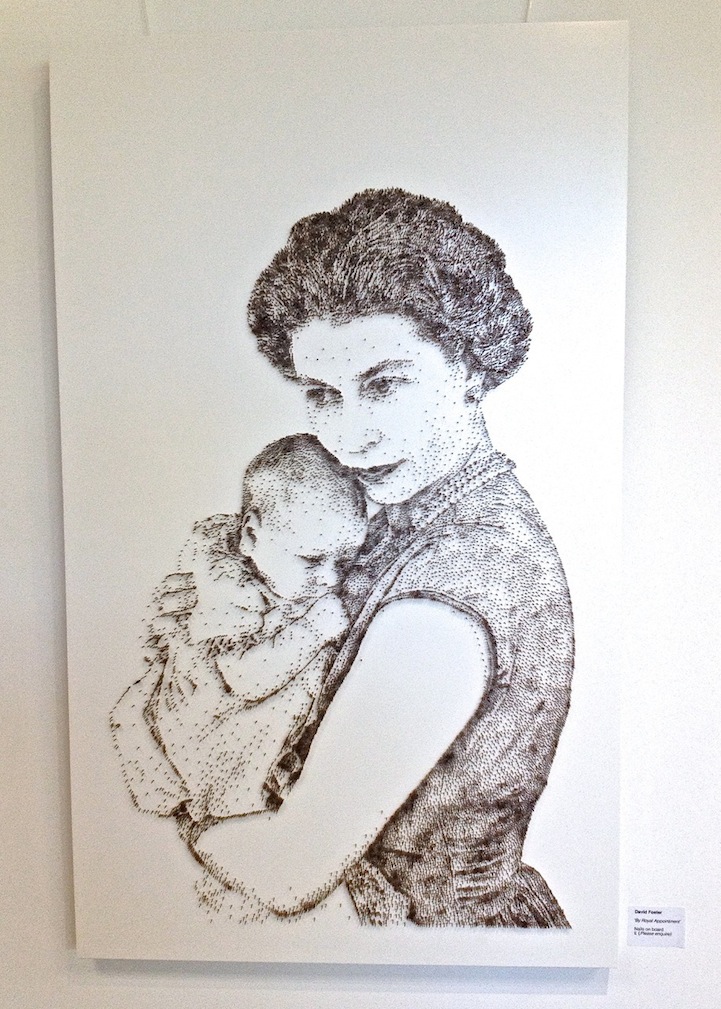
For up to three weeks straight, U.k.-based artist David Foster transforms an all white canvas into an incredible portrait by hammering in thousands of nails. Many of his pieces are portraits of instantly recognizable people including Nelson Mandela, Marilyn Monroe and Bob Dylan. Originally an builder, Foster draws on his technical drawing background to carefully programme and construct his artwork. Like many artists featured here, there is no room for mistakes. As he explains, "On a white background, ane boom in the wrong place can ruin a film and waste weeks of piece of work. I can't paint over the pigsty or fill information technology in because those corrections would exist noticeable."
Foster's pointillist images take on average 5,000 nails, but that number can get as loftier as 30,000. His technique has evolved over fourth dimension, and the artist at present prefers tiny nails so that the viewer can interpret the work more closely and in greater detail. In his studio, he has over a one-half a meg of these nails, waiting for their new "abode."
The artist recently exhibited at The Liverpool Contemporary Art Fair and has many of his works in galleries across the Uk.
iv. Michael Mapes (Collage of Objects)
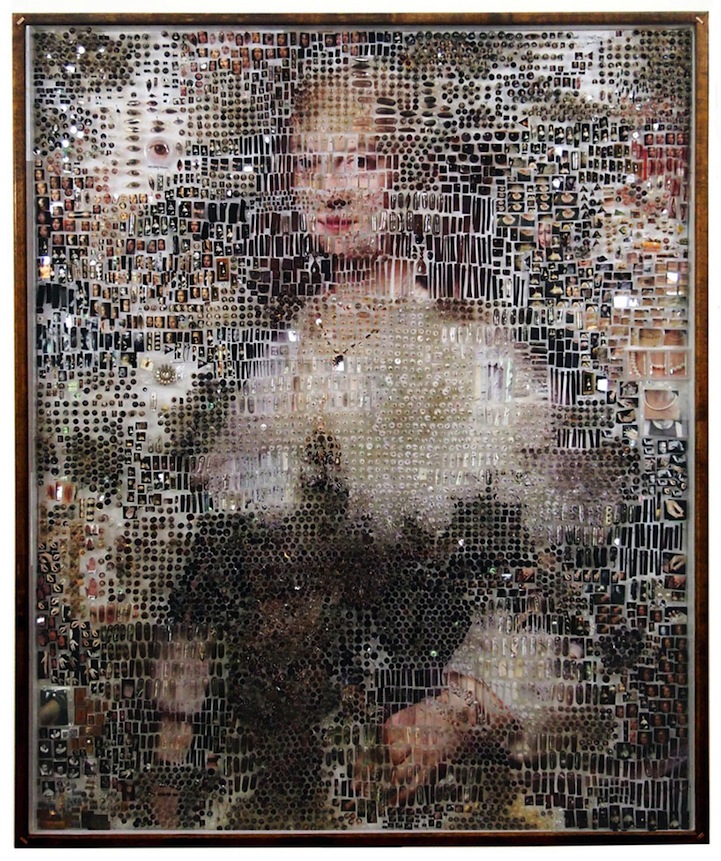
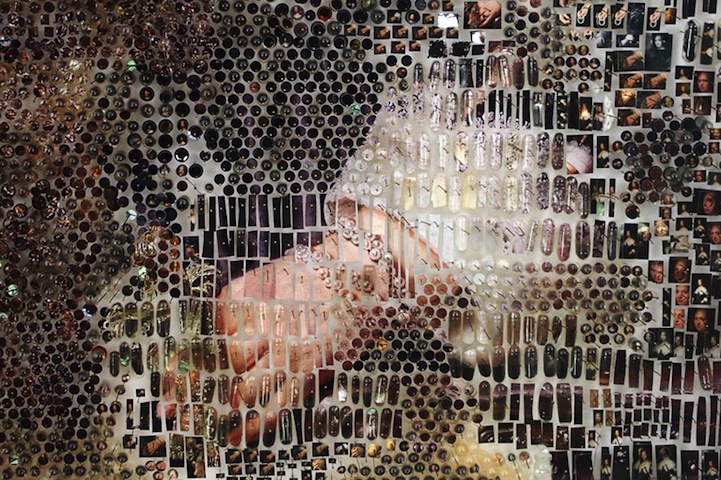
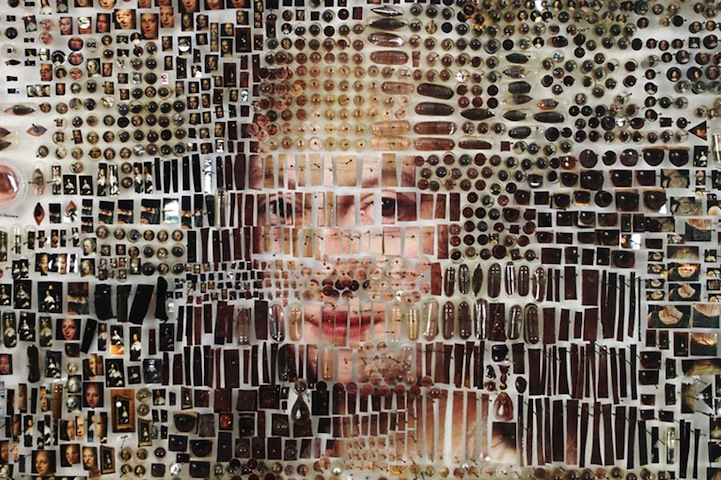
Artist Michael Mapes has created an intriguing series inspired past the beautiful 17th-century paintings of Dutch masters like Rembrandt, Vermeer and Nicolaes Eliasz Pickenoy. On elevation of a white foam board like those used by entomologists to pin insect specimens, Mapes assembles miniature objects including photographic prints, gelatin capsules, glass vials and chaplet until they form i cohesive portrait. The work seen here, Dutch Specimen MT1639, is composed of over v,000 pieces.
"They're fairly irksome to create," he says, "and so I try to bring a painter-like approach to working on them. Making changes that involve then many individual elements can exist challenging, if non punishing, but my interest lies in discovering the composition of the work while making it."
Mapes has many upcoming exhibitions this year. In London, he'll prove five works alongside ii other artists as a part of Beers Contemporary's show Cut-Copy-Paste from Baronial 1st to September 27th. In the Hague, he'll be a part of the show Revisiting the Golden Historic period at Pulchri Studio from August 9th to August 31th. Excitingly, Dutch Specimen MT1639, the very first work in Mapes' Dutch series, will be exhibited for the next two years at the residence of the US Ambassador to The Netherlands in The Hague as part of the Fine art in Embassies program.
5. Pei-San Ng (Matches)
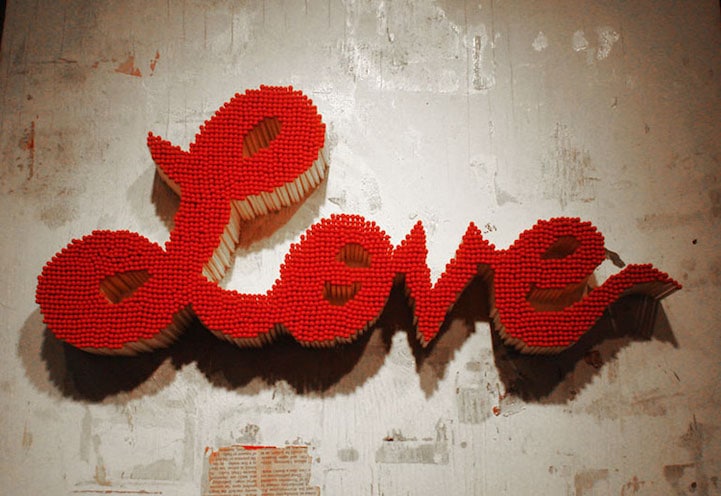
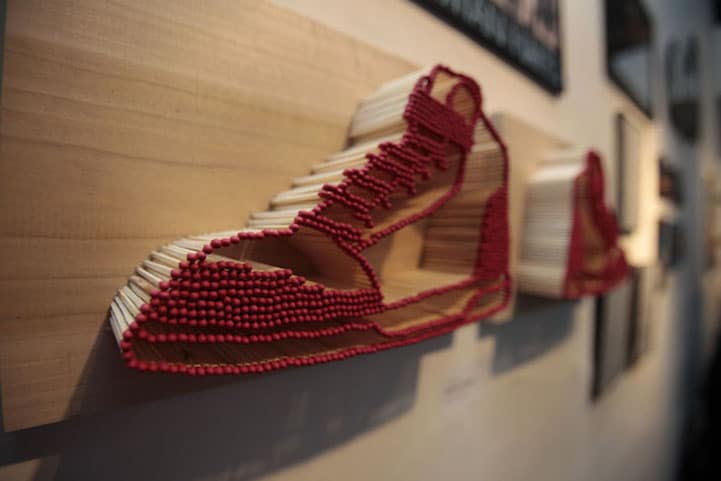
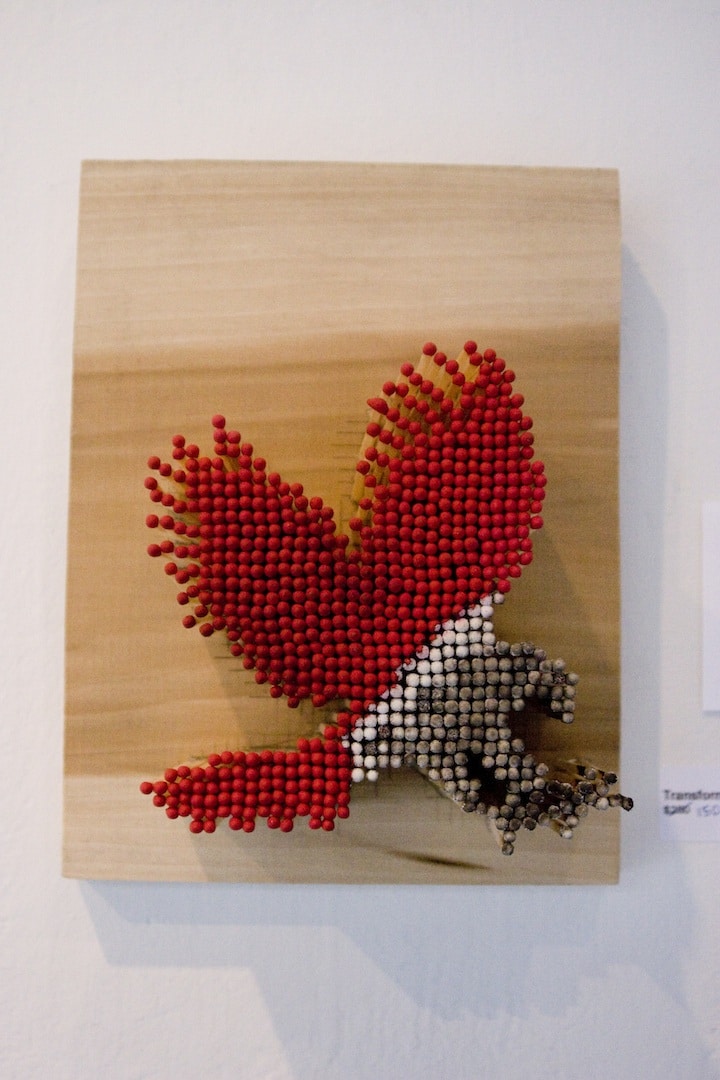
Chicago-based artist Pei-San Ng takes thousands of antiquarian matches and assembles them into everything from beautiful typography to an image of a phoenix. From concept to completion, her works take about ii months to complete – with a big portion of that fourth dimension devoted to developing the idea – and all conduct a deep meaning.
"I want the concept to be intertwined with the textile, since the image or text has to circumduct around fire in one way or another," she says. "Non only must I break down an paradigm or word into evenly spaced dots, merely I must also decide what colors to use. Then, associates begins. This, in some ways, is the simplest office, because I believe in the idea enough to spend hours and hours of gluing."
Depending on the size of the slice, assembly tin require days or fifty-fifty weeks of deadening repetition, all edifice up to the most fun part for the creative person: burning. In betwixt, she adds, "I rely heavily on hot tea, dorsum rubs and lots of Chinese television dramas."
Ng is currently experimenting with displaying her work at less traditional gallery spaces like fire stations. She's also interested in creating more site-specific piece of work.
half-dozen. Andrew Myers (Screws)
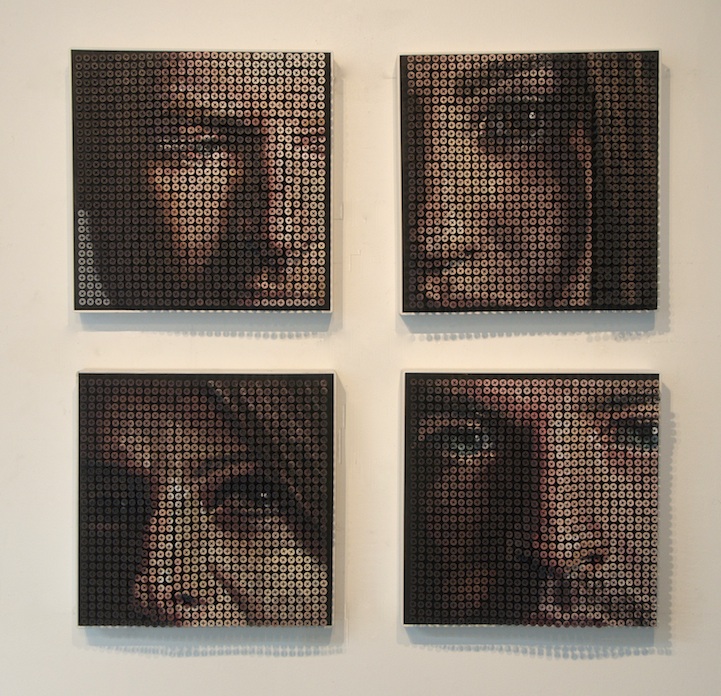
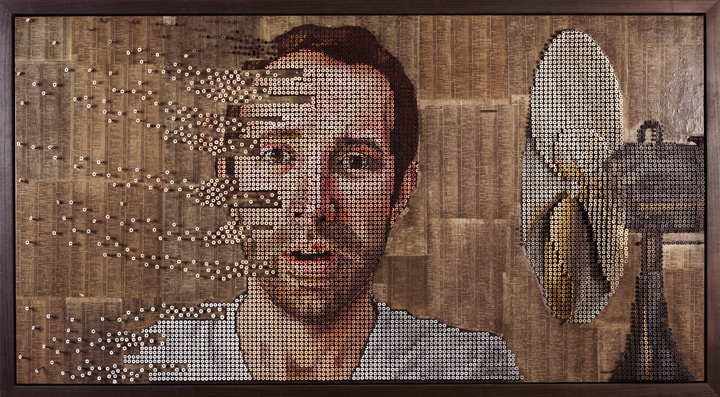
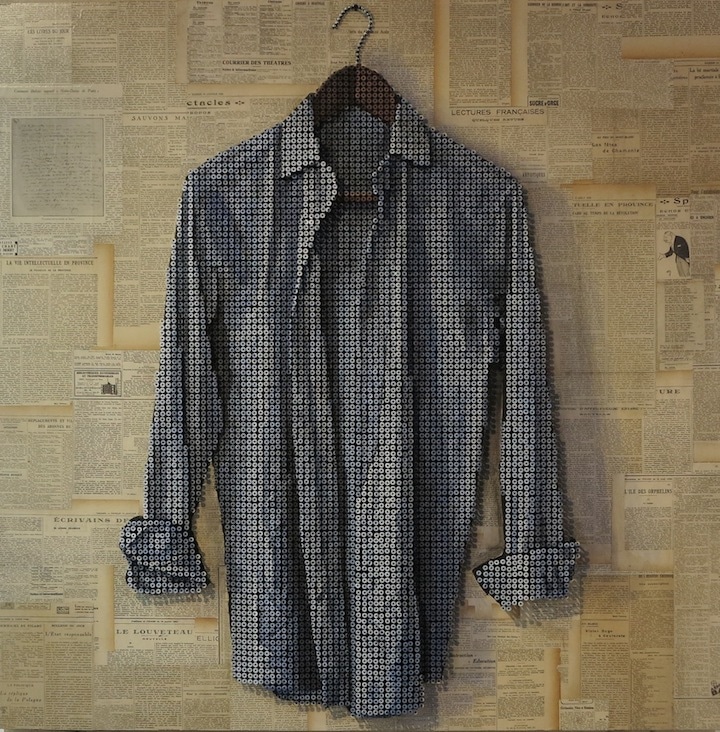
Remarkably, Andrew Myers doesn't rely on calculator software to create his three-dimensional portraits – the Laguna Embankment-based artist does everything by manus. Starting with a plywood panel, he drills 8,000 to 10,000 holes and places in screws at varying heights. Then he paints over each individual head, keeping in mind where shadows naturally prevarication. (One of his latest works is a set of four close-ups portraits of faces. Taken all together, that ready measures an enormous 12 feet by 12 feet.)
Myers says that his greatest challenge is the labor. "Information technology can exist physically draining to install spiral after screw for hours on cease," he says. "These pieces take anywhere from 2 to 6 months, depending on the size and subject matter."
A blend of both a sculpture and painting, these are unique works one can simply fully appreciate in person. The artist volition be showcasing his latest piece at The Festival of Arts in Laguna Embankment from July 5th to August 30th.
7. Ran Hwang (Buttons, Beads and Pins)
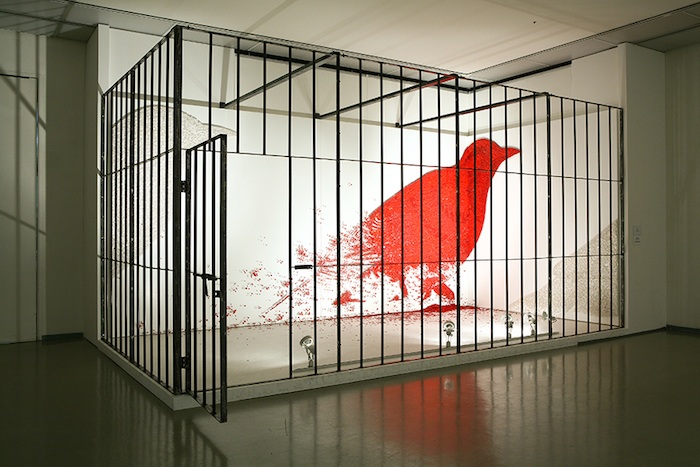
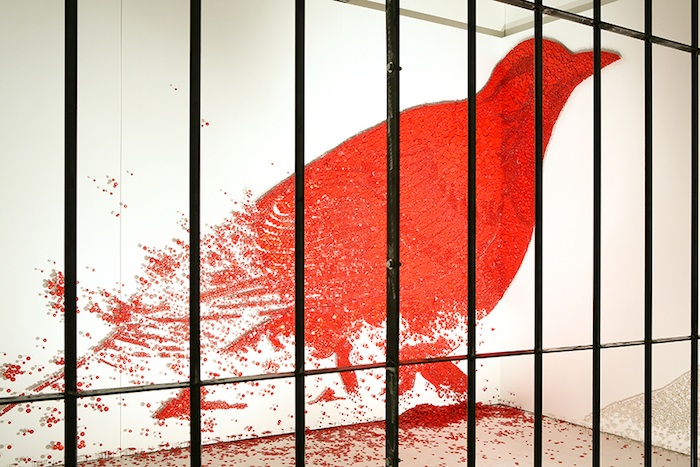
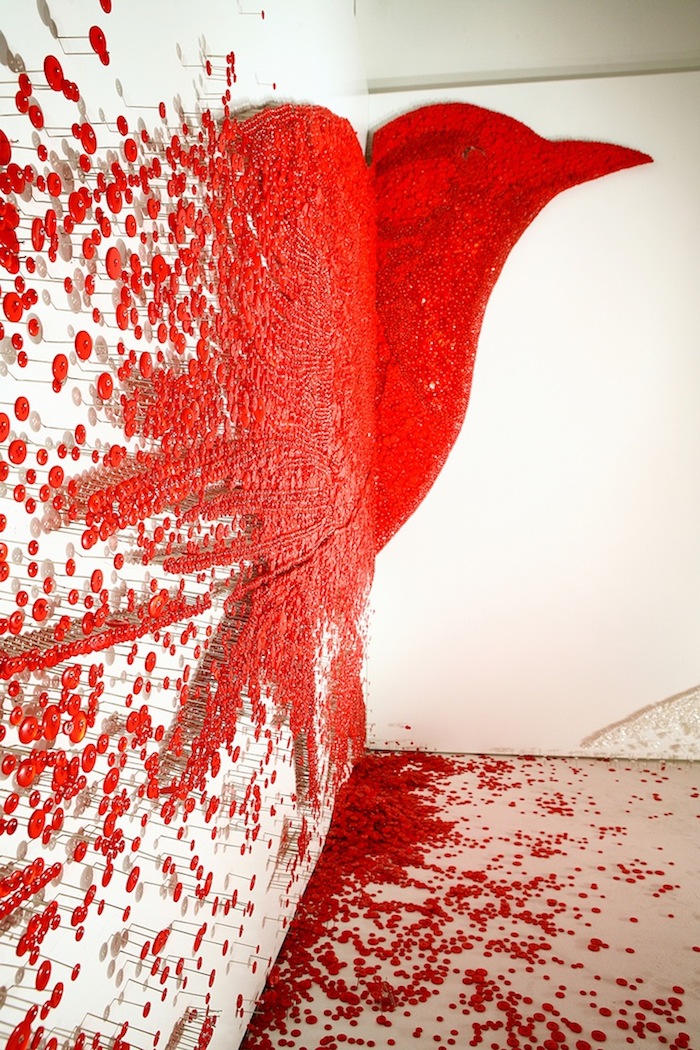
Korean-born and Brooklyn-based artist Ran Hwang creates amazing murals using tiny materials typically associated with habiliment – buttons, chaplet and pins. Extremely fourth dimension consuming and very repetitive, each slice takes an incredible amount of piece of work. Hwang recalls that when she first was starting, she'd only be given three to 7 days to complete an installation, so she'd be hammering pins and buttons directly on gallery walls all night long. Now, her large-scale pieces, which average more than thirty feet wide, take her about a year to complete, whereas smaller works take effectually iii months.
For the piece to a higher place, Dreaming of Joy, Hwang leveraged close to sixty,000 scarlet buttons and pins to create a gigantic 16-foot high bird. In her typical style, Hwang left a scattering of pins on the floor, below the silhouette of the image. Though at get-go glance the work may seem unfinished, Hwang deliberately left a pile of buttons on the floor. The artist shuns utilize of whatever gum, and so that buttons stay or fall on their own accord.
Until August 31st, you can encounter Ran Hwang's work in a solo exhibition at AAW Gallery in Beijing, China. Next March, she'll too exist showing her work at New York'south Armory Show, where she'll be represented by Leila Heller Gallery.
Source: https://mymodernmet.com/7-artists-create-intricate-works-assembling-thousands-pieces/

Posting Komentar untuk "If We Can Recognize the Objects or People in a Work of Art It Is"